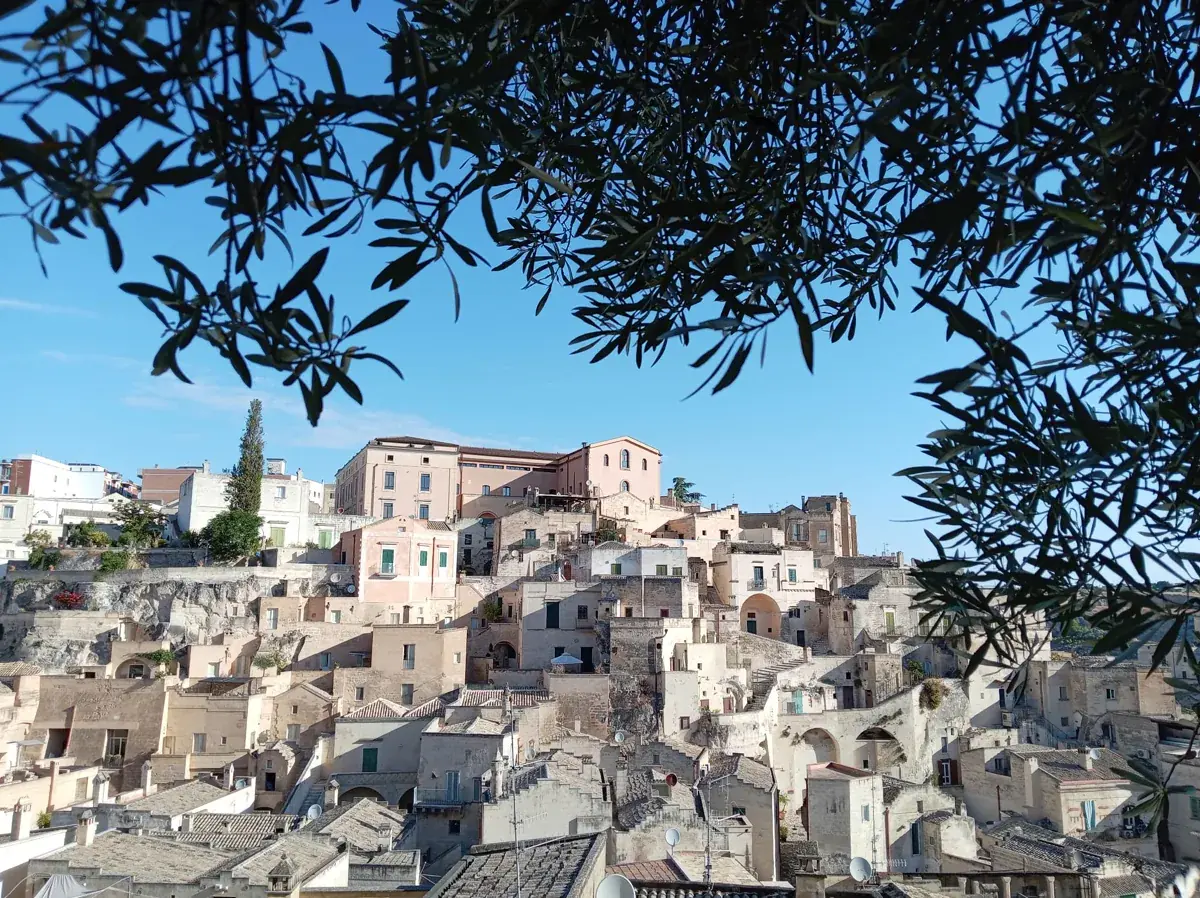
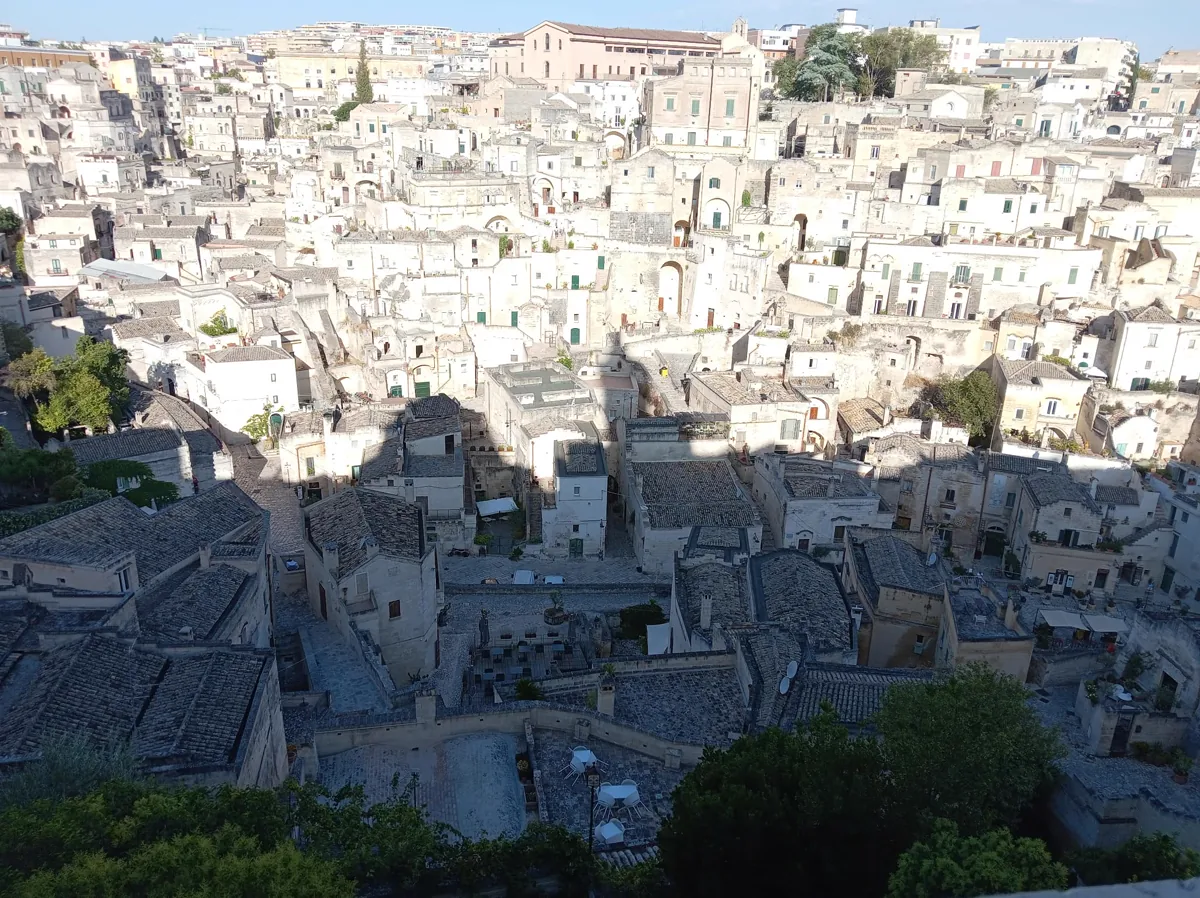
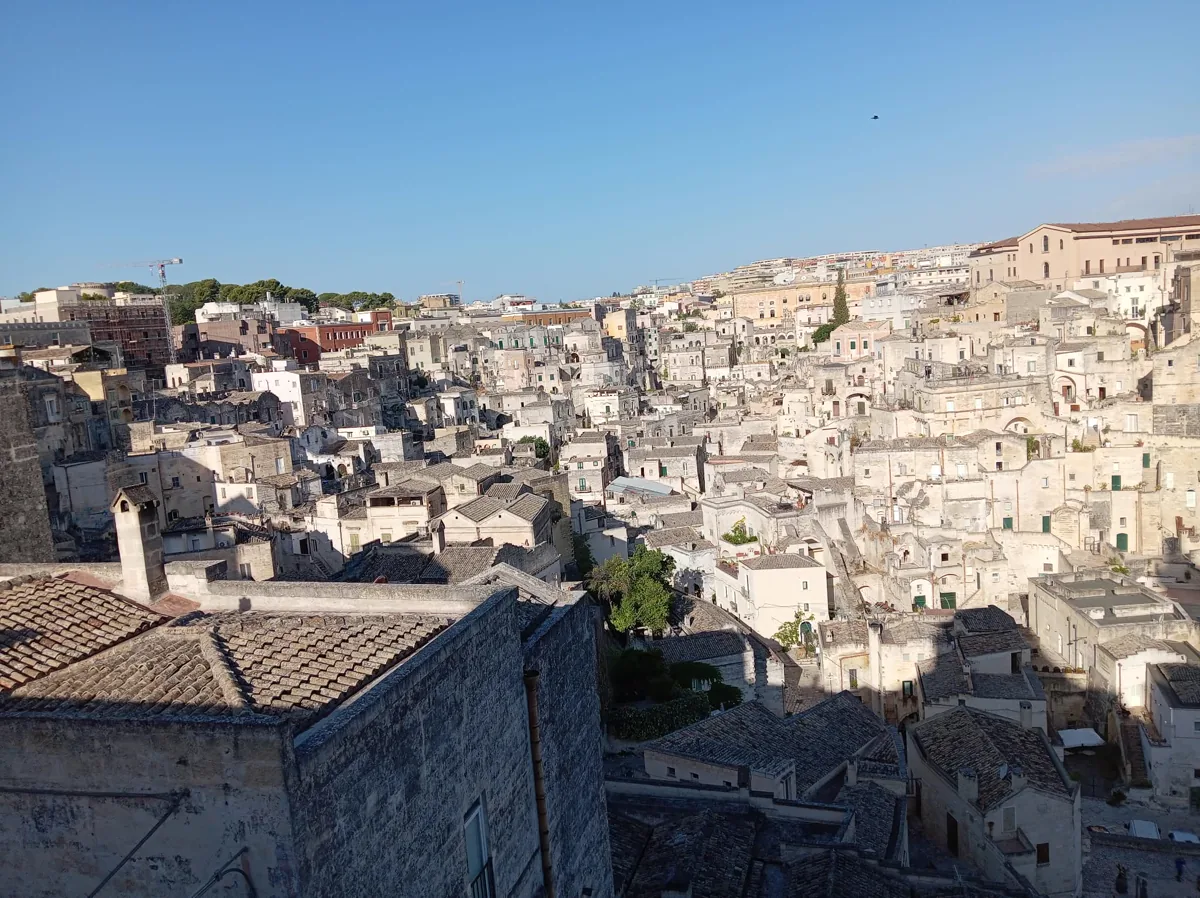
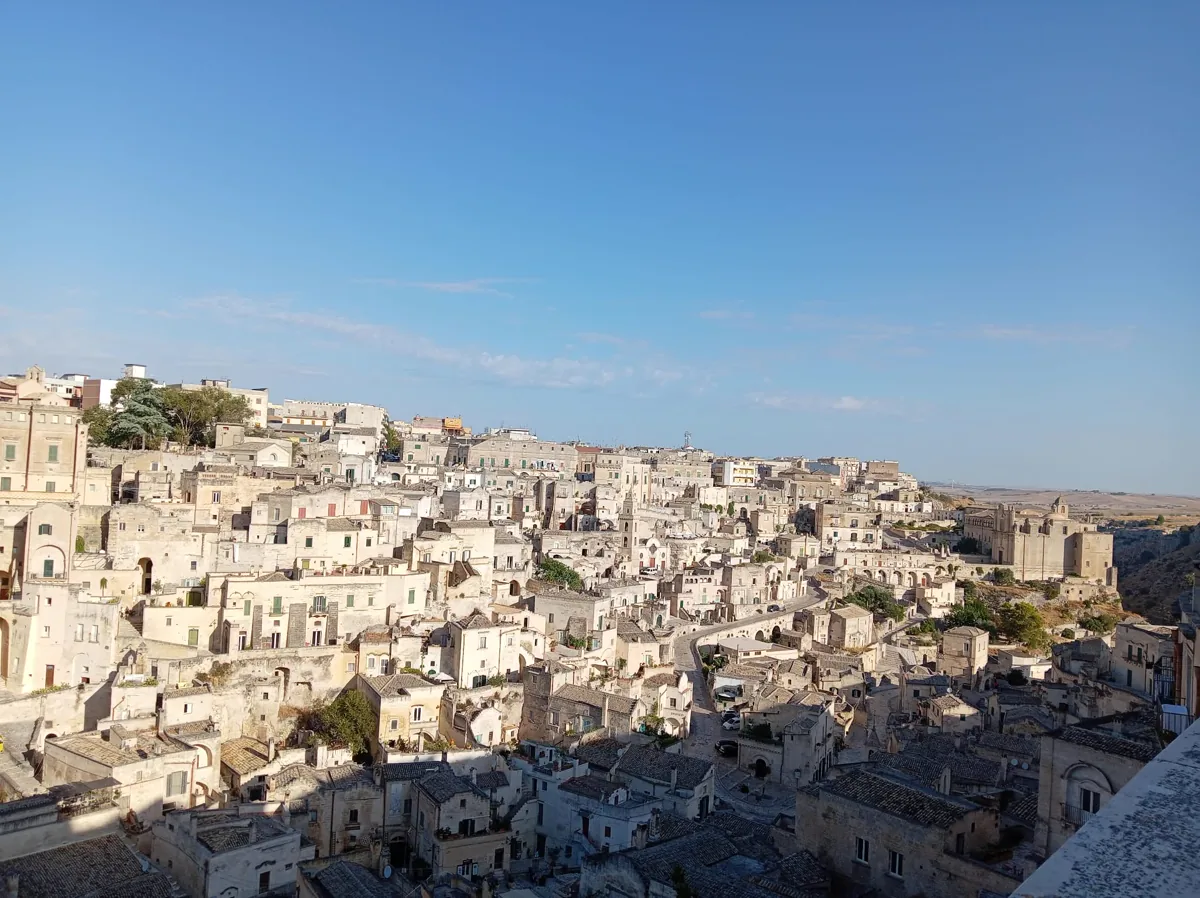
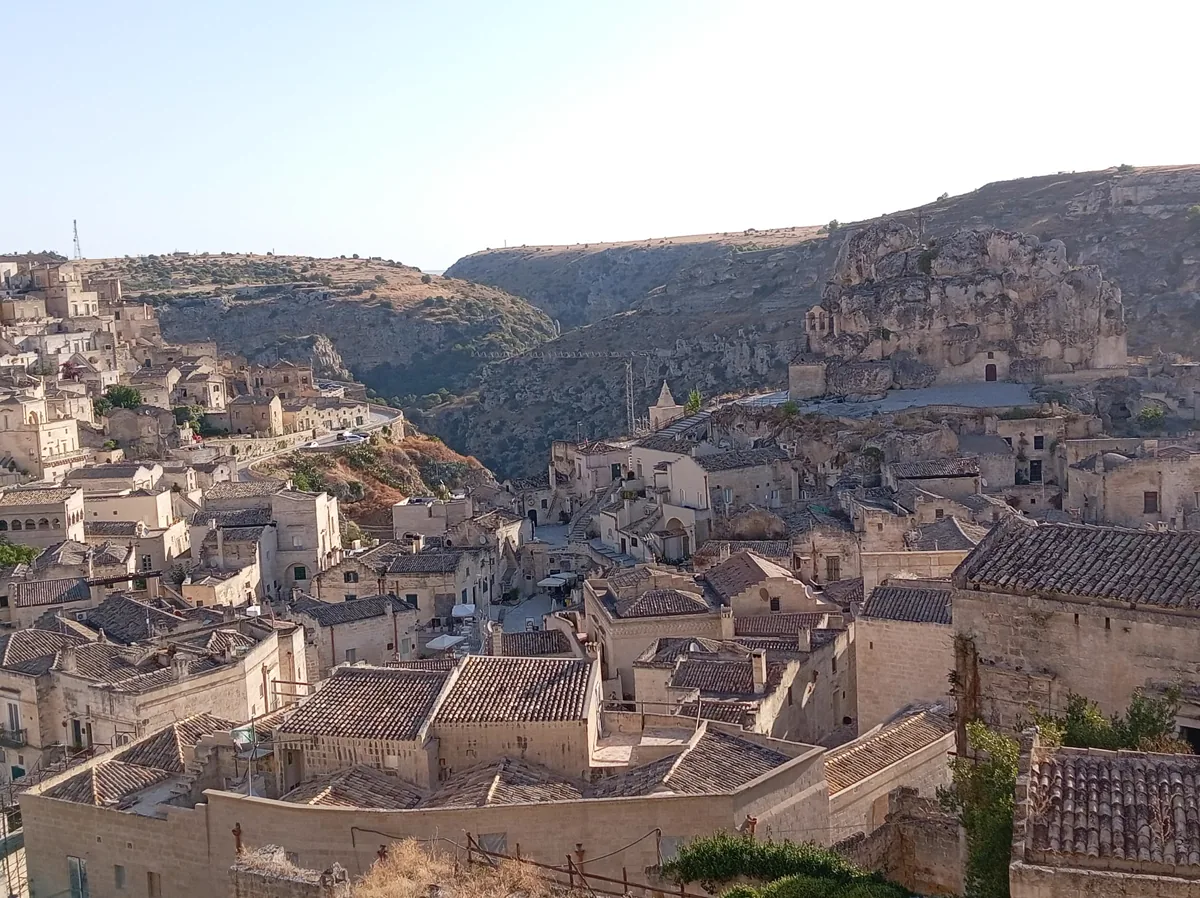
The Sassi are not a district like any other: they are cut into the limestone. Cave dwellings, cisterns, staircases and churches form a fabric that grew over millennia – and where thousands of people were still living until seventy years ago. Today they are on the UNESCO World Heritage list.
What the Sassi actually are
Matera sits on the edge of a gorge, the Gravina. Into its soft limestone people have driven caves since prehistoric times, then widened them, built over them and stacked them higher. What looks from the outside like a piled-up city of houses is largely hollowed-out rock: the building material for the façade came from the space that opened up behind it. So when you see a wall, you are often only looking at the front extension – the actual living space lies behind it, inside the rock.
The stone itself makes this possible. Fresh from the quarry it can be cut with a saw, and it hardens in the open air. The same property that made building easy also makes it vulnerable: damp and salts break it down, which is why many frescoes in the rock churches survive only in fragments.
Two districts, two characters
The Sassi consist of two areas, separated by the rock spur of the Civita, on which the cathedral stands.
The Sasso Caveoso to the south feels more archaic. Here the caves lie more openly on the slope, terraced above the gorge, stacked like the tiers of an ancient theatre – hence the name. The Sasso Barisano to the north is more heavily built over, with stone façades, doorways and lanes that look more like an ordinary old town – until you realise the rooms behind them are inside the rock.
Within both districts, residents were organised into rioni – small neighbourhoods with their own church and a shared courtyard.
Water as the key
Without a well-thought-out water system, settlement here would have been impossible. The limestone is porous and there are hardly any springs. Rainwater was therefore collected from roofs, terraces and channels and led into cisterns that were likewise cut into the rock. Almost every cave dwelling had its own. The largest communal system, the Palombaro Lungo, lies beneath the central square of the upper town and has the dimensions of a cathedral.
From destitution to World Heritage
In the twentieth century the Sassi became a byword for bitter poverty. Families lived with their animals in windowless caves; water was scarce, the air was bad, child mortality was high. Carlo Levi described the conditions in Christ Stopped at Eboli, and after the war Italian politicians spoke of a “national disgrace”.
From the 1950s onwards the inhabitants were resettled by law into newly built districts on the edge of town – around fifteen thousand people. The Sassi then stood empty for decades and fell into decay. The turnaround came late: in 1993 UNESCO added the Sassi and the Park of the Rock Churches to the World Heritage list, and in 2019 Matera was European Capital of Culture. Today many caves have been restored – as homes, hotels, workshops and museums.
This history is why a visit here feels different from other old towns: what is now considered beautiful was, until recently, a place people were taken out of. Casa Noha tells the story of that rupture in half an hour.
How best to experience the Sassi
On foot, and twice, from different directions. Once from the outside – from the opposite slope of the Murgia, where the city stretches across the gorge in its full width. And once from the inside, in a furnished cave dwelling, where a silhouette turns into a household.
For the walk itself: wear sturdy shoes, because almost every route runs over steps and paving worn smooth by feet. Bring water, because there is barely any shade along the way. And allow plenty of time – the distances are short, but nobody covers them quickly.
When to come
Spring and autumn are pleasant; high summer is harsh on the bright stone. Within the day the rule is simple: in the morning and in the last hour before sunset the sun is low, and the terraces stand out in relief. At midday the same slope looks flat and pale – that is the time for museums and for everything underground.
Read on
- Sasso Caveoso – the southern district above the gorge
- Sasso Barisano – the northern, more built-up district
- The lanes of the Sassi – which route leads where
- Rock churches in and around Matera – the churches in the stone
- Viewpoints in Matera – where to see the whole picture from
Plan your visit to Matera
Two-day Matera itinerary · Getting to Matera from Bari airport.