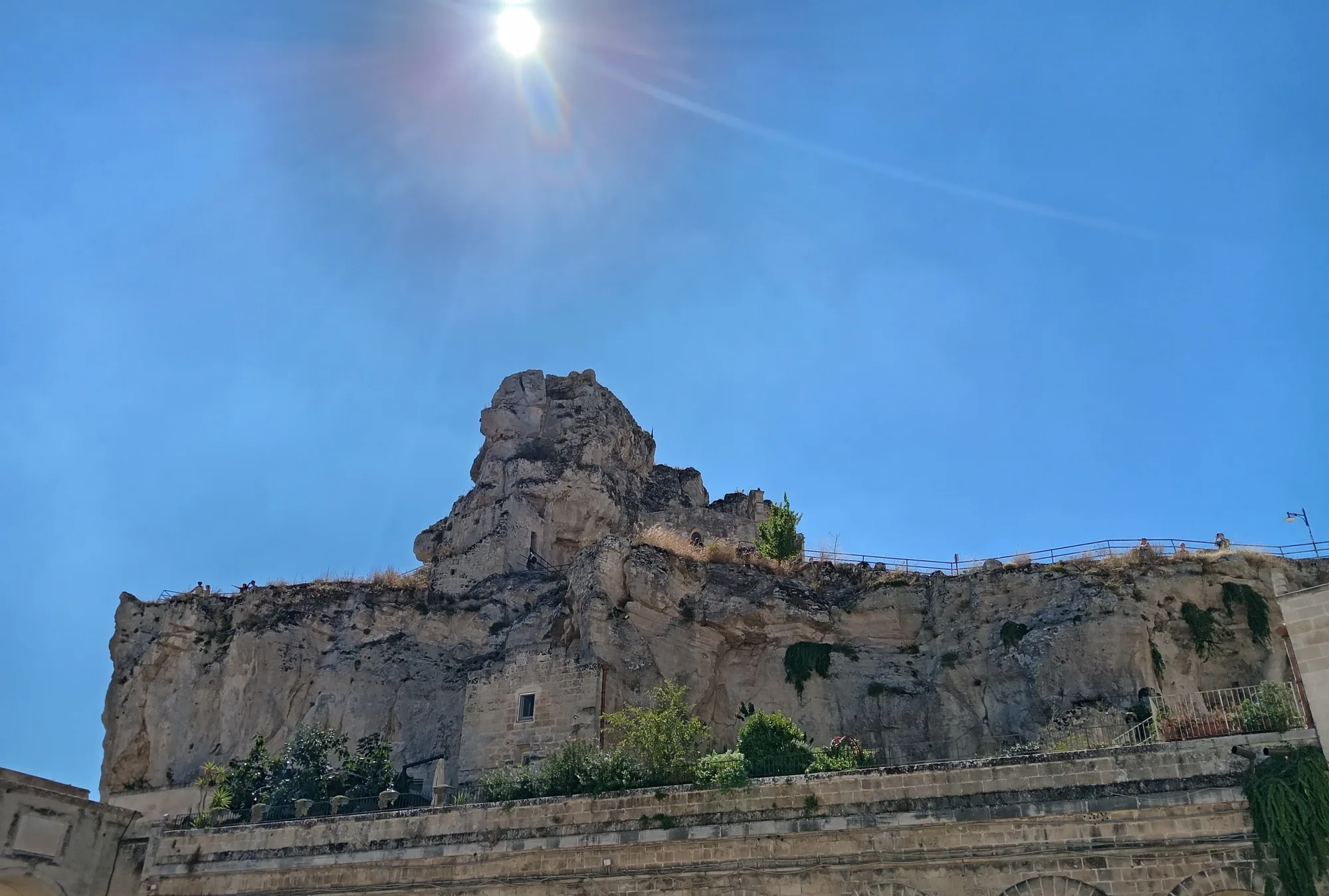
The church sits inside the Monterrone crag in the middle of the Sasso Caveoso. From below you mostly see the rock – the church is inside it, and only the white façade gives it away.
The Monterrone
The rock rises out of the slope of the Sasso Caveoso like a boulder – a harder block that erosion left standing while the ground around it was worn away. Santa Maria de Idris was cut into it, its plain façade pressed against the stone as if stuck on afterwards. The name points to water: idris goes back to the Greek word for water, and cisterns lay nearby.
Two churches in one rock
Inside, a passage leads to the neighbouring cave church San Giovanni in Monterrone; the two are visited together. The connecting passage is considered the most rewarding part: here the images of saints stand close together, partly painted over one another, and you can see clearly how the space was won from the rock – chisel mark beside chisel mark.
What there is to see
Frescoes from several eras survive. Some figures are strong and complete, others recognisable only as outlines. This unevenness is typical: where damp moved through the rock the colour was lost; where the stone stayed dry it held for centuries.
The view and the crowds
From the forecourt the view reaches across the Sasso Caveoso to the gorge and the Murgia opposite. Because the space is small and the way up runs over a narrow staircase, it gets tight at peak times. Early in the day is quieter – and the light on the crag is better then anyway.
Read on
- San Giovanni in Monterrone – the linked church in the same rock
- San Pietro Caveoso – the church and square below
- Sasso Caveoso – the district around it