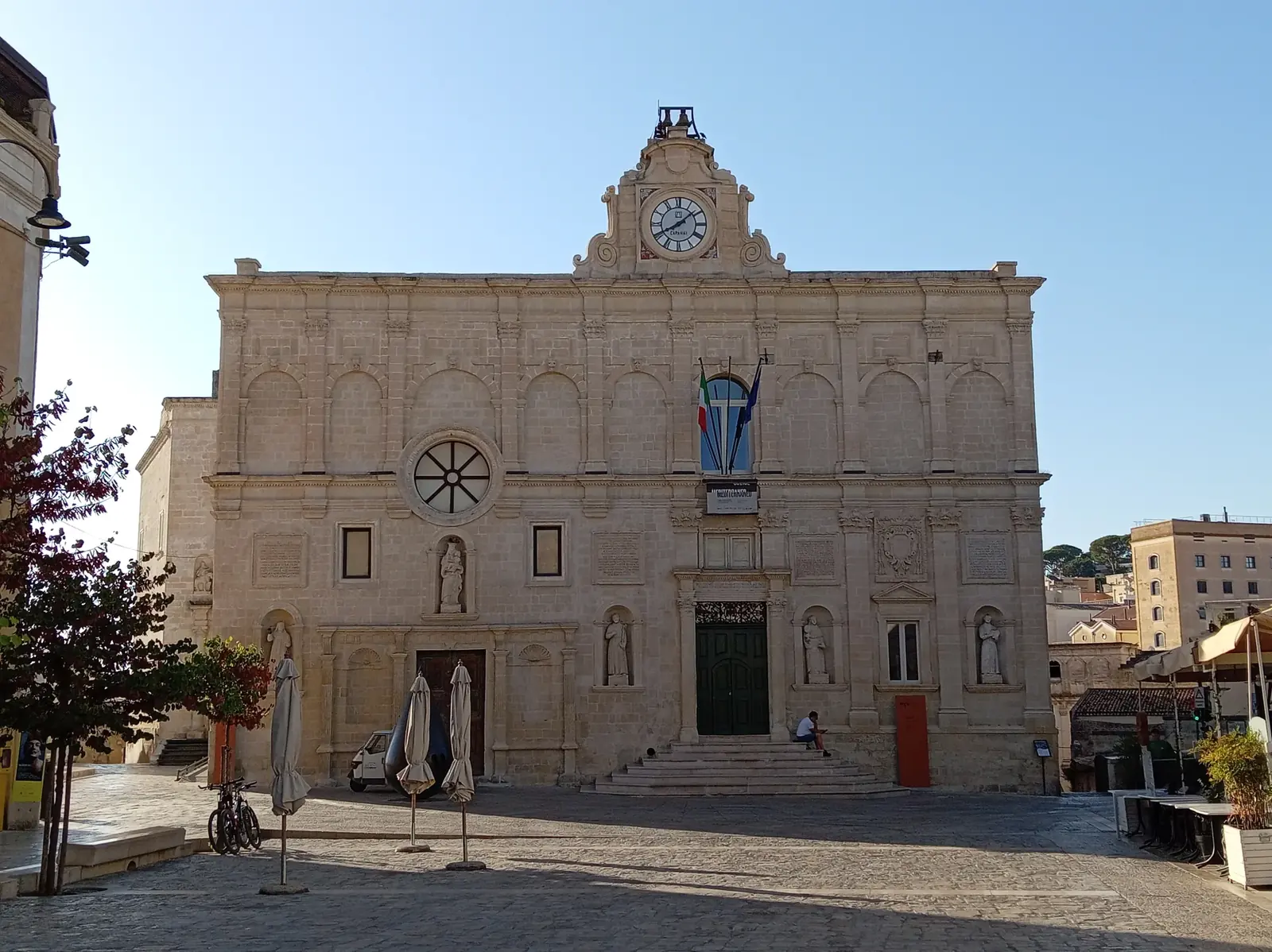
The large palace at the edge of the upper town houses the regional museum of medieval and modern art of Basilicata – including Carlo Levi’s mural Lucania ’61.
The building
The palazzo was built in the seventeenth century as a seminary and dominates the square at Piazzetta Pascoli with its broad front. It marks the end of Via Ridola and thus the point where the upper town breaks away to the Sasso Caveoso. Coming out of the city, you stand suddenly in front of the whole view.
What there is to see
The collection runs from medieval sacred art through painting of the region to the present. Among the holdings are panel paintings, sculpture and furniture from churches and monasteries of Basilicata – pieces brought together here after their houses were dissolved.
Lucania ’61
The best-known work is the large mural Lucania ’61 by Carlo Levi – a narrative panorama of the rural south, painted for an exhibition marking a hundred years of the Italian state. Levi had lived in Basilicata as an exiled doctor and writer; his book Christ Stopped at Eboli made the conditions of the region known in Italy and fed into the later clearance of the Sassi.
The painting is therefore more than an exhibit: it is among the reasons the city looks the way it does today.
Outside the door
The terrace in front of the palace is one of the most popular viewpoints in the city – from here the view falls across the whole Sasso Caveoso. It is reached on the level and is thus one of Matera’s few low-barrier views.
Read on
- Piazzetta Pascoli – the terrace in front
- Museo Ridola – the archaeological museum on the same street
- Museums in Matera – all the houses compared